EN
 Italiano
 Deutsch
 Français
 Español
 Polski


Common mistakes arriving at Dublin airport
Most transfer problems at Dublin airport aren’t about missing a bus or a taxi. They’re about misjudging things that seem minor beforehand and turn out to matter on the day: how bad the M50 actually gets, which terminal a flight uses versus which terminal a connection needs, and how far a city-centre stop really is from a specific hotel. None of these are hard to plan around once they’re on the radar.
Underestimating the M50 at the wrong time of day arriving at Dublin airport
Dublin airport sits about 10 kilometres north of the city centre, and the most common route in touches the M50 orbital motorway before joining the quays. The M50 carries a large share of Dublin’s cross-city traffic, and its worst congestion windows, roughly 7:30 to 9:30 in the morning and 16:30 to 18:30 in the evening on weekdays, can add well over the scheduled journey time to any road-based transfer, Terravision’s bus included. A trip that normally takes under an hour can stretch past ninety minutes if a flight lands in the middle of evening rush hour, which matters most for travellers with a tight onward connection, a scheduled meeting, or a strict hotel check-in window. Terravision’s bus keeps to the same route as every other road transfer, so the traffic risk applies equally to it, a taxi, or a rental car; the difference is that a bus ticket, unlike a taxi meter, doesn’t cost more when traffic runs long.
Weekend traffic follows a different, sometimes counterintuitive pattern: Saturday afternoons around major shopping and event periods can rival a weekday rush hour, while Sunday mornings are usually the lightest traffic Dublin sees all week. A traveller comparing flight times purely by weekday commuter logic can end up choosing a Saturday afternoon arrival that’s actually busier than a weekday one, simply because weekend congestion doesn’t follow the same predictable two-window pattern.
Confusing the terminal that matters for flights with the one that matters for buses
Dublin airport has two terminals, and travellers sometimes assume that distinction carries over to ground transport the way it does to connecting flights. It doesn’t, at least not for Terravision: one ticket covers pickup at either Terminal 1 or Terminal 2, since both stops run the same route on the same schedule. Where terminal confusion genuinely costs time is with a connecting flight, since T1 and T2 are separate buildings joined by a landside walkway that takes five to fifteen minutes to cross, and any airside connection still requires clearing security again on the departure side. Travellers who mix up the two terminals for their onward flight, rather than for their bus, are the ones who actually lose meaningful time.
Assuming a city-centre stop is the same as a hotel address
Terravision’s bus serves around ten stops along the quays, including Aston Quay, Eden Quay and Wellington Quay, and it’s easy to book a ticket assuming whichever stop sounds most central will be close to a specific hotel. The quays run for a couple of kilometres along the River Liffey, and a stop that’s a five-minute walk from a Temple Bar hotel can be a twenty-minute walk, through several street crossings, from one near the Docklands or the IFSC. Checking which named stop actually sits closest to the accommodation, rather than picking one because it sounds central, avoids an unplanned walk with luggage at the end of the journey.
This mistake compounds when a traveller books a return ticket without checking whether the pickup stop for the airport-bound leg matches the drop-off stop used on arrival. Not every stop along the route operates in both directions in exactly the same sequence, so confirming the return pickup point at booking, rather than assuming it mirrors the arrival stop automatically, avoids a last-minute scramble to find the right corner on departure day.
Not budgeting time for security and preclearance on departure
This one runs the other direction, from city to airport, but it belongs on the same list because it trips up the same kind of traveller who underestimates the M50 coming in. Terminal 2’s US Preclearance facility, used by passengers flying directly to the United States, adds a distinct immigration step before the security queue that Terminal 1 passengers never encounter, and it can take considerably longer during peak departure banks in the early morning and late afternoon. A Terravision bus scheduled with what looks like a comfortable buffer before a US-bound flight can still leave uncomfortably little time once preclearance is added to the usual security wait, so that route in particular deserves a wider margin than the standard two-hour recommendation.
Treating flight delay coverage as automatic without checking
Terravision tickets for the Dublin route remain valid on a later departure the same day if a flight is delayed, which removes one common source of stress, but it’s still worth knowing this applies to the day of travel, not an open-ended window. A traveller whose flight is pushed into the following day, rather than simply delayed by a few hours, will need a new ticket rather than assuming the original one still applies. Checking the specific delay policy at the time of booking, rather than assuming it works exactly like a different provider’s policy, avoids a surprise at the pickup point. The same logic applies in reverse for an early flight: arriving at the airport stop well ahead of a booked departure doesn’t guarantee a seat on an earlier bus if that one is already full, since the ticket is tied to a specific time slot rather than open to any departure that day.
Frequently asked questions
What time of day should I avoid for a Dublin airport transfer if I want to skip traffic?
The tightest windows are weekday mornings from roughly 7:30 to 9:30 and evenings from 16:30 to 18:30, when the M50 and the routes feeding into the city centre carry the heaviest commuter traffic. A journey that normally takes under an hour by bus or taxi can stretch well past ninety minutes if it falls squarely inside one of these windows, so a flight landing or a departure scheduled around those times benefits from extra buffer time regardless of which transfer option is chosen.
Does it matter which Dublin airport terminal I land at for my Terravision bus?
No, a single Terravision ticket covers pickup at either Terminal 1 or Terminal 2, since both stops run the same schedule and route into the city. Terminal confusion matters far more for a connecting flight, where switching between T1 and T2 means a walk of five to fifteen minutes plus a fresh security screening, than it does for boarding a bus that serves both buildings identically.
How do I know which Dublin city-centre stop is closest to my hotel?
Check the hotel’s address against the list of Terravision stops along the quays, which include Aston Quay, Eden Quay and Wellington Quay among others, rather than assuming any city-centre stop is close enough. The quays run for roughly two kilometres, so the difference between the nearest stop and the wrong one can be a twenty-minute walk with luggage, particularly for hotels set back from the river in areas like the Docklands or Temple Bar’s quieter side streets.
Explore Dublin airport transfers

 Rides approx every 30 mins
 Journey time: 60 mins
 Free Luggage
 No Booking fee

approx every: 30 mins
Journey time: 55 mins
Free Luggage
No Booking fee
Whaf if you arrive early ou late at night at Dublin airport ?
November 17, 2026
Dublin airport to city centre during match days and concerts
November 17, 2026
St Patrick’s Day in Dublin: getting from the airport during the busiest week of the year
November 11, 2026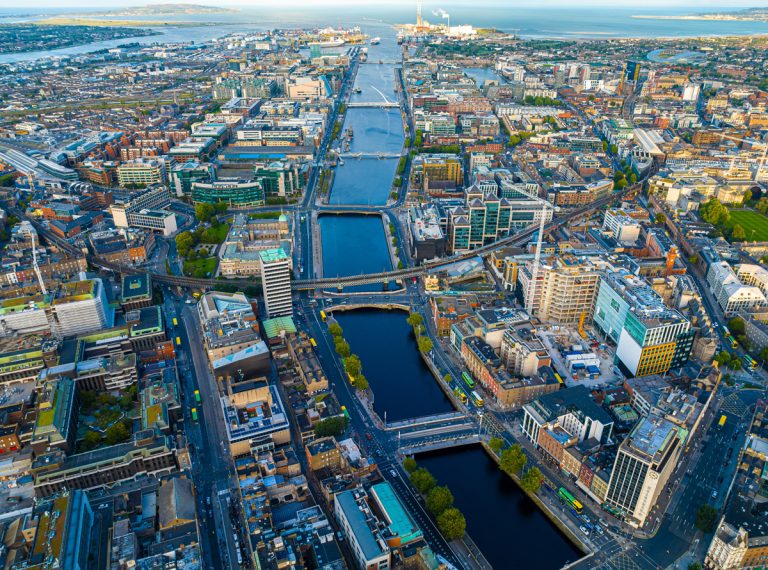
Dublin airport T1 vs T2: does it matter for your Terravision transfer?
November 10, 2026
Dublin airport to Belfast by coach: what changes crossing into Northern Ireland
November 3, 2026