EN
 Italiano
 Deutsch
 Español
 Polski


Keflavik airport to Reykjavik: how long does it really take?
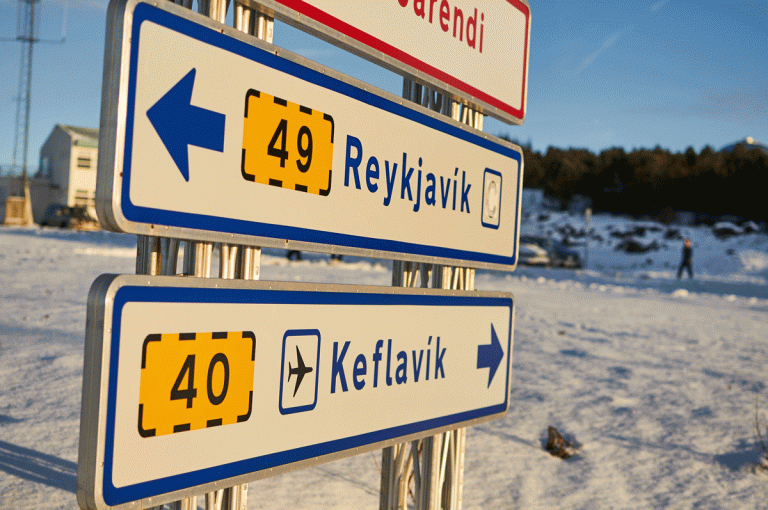
Every Iceland guide quotes the same figure for the drive from Keflavik airport to Reykjavik: 45 minutes. That number holds up on an ordinary day, but Iceland’s weather doesn’t always cooperate with ordinary days, and the 50-kilometre stretch of Route 41 between the airport and the capital runs across an exposed lava-field peninsula with nothing to block coastal wind or blowing snow. Knowing when 45 minutes is reliable, and when it genuinely isn’t, matters more here than at most airport transfers in Europe, particularly for a first-time visitor who has never driven or ridden through this kind of open volcanic landscape before.
Going from Keflavik airport to Reykjavik : Terravision’s answer
Terravision’s bus from Keflavik airport covers the route in 45 minutes on a normal day, running direct into Reykjavik city centre with no intermediate stops, departing every 60 minutes throughout the day. Because the service runs on a scheduled timetable rather than a per-flight shuttle, the departure time is fixed and known in advance, which makes it easier to plan a day around than a shuttle that leaves whenever it fills up. The 45-minute figure is the schedule’s baseline under normal road and weather conditions, and it’s the number worth planning around for the vast majority of trips. It’s also worth noting that this transfer time is essentially identical to what a rental car or a private taxi would take on the same road, since the constraint is the road and the weather, not the vehicle, so choosing Terravision over a pricier alternative doesn’t cost any meaningful time under normal conditions.
Where the extra time actually comes from
Route 41, known locally as Reykjanesbraut, is a well-maintained dual carriageway, and under clear conditions there’s little to slow a bus down over the 50 kilometres it covers. The variable is weather: Iceland’s Reykjanes peninsula is flat, coastal and largely treeless, which means crosswinds and blowing snow reach the road with nothing to soften them. During a winter storm, Icelandic road authorities do reduce speed limits or close sections of Route 41 outright, and even short of a full closure, high winds alone are a common reason for buses and cars to slow down well below the posted limit. On a genuinely bad-weather day, a scheduled 45-minute transfer can stretch to well over an hour, and it’s worth checking road.is, Iceland’s official road conditions site, before travelling if a storm is forecast.
Darkness plays a smaller but real role too, particularly in the deep winter months when Reykjavik sees only four to five hours of daylight around the winter solstice. Driving conditions at night on an unlit stretch of coastal road are inherently more cautious than in daylight, even without a storm involved, and bus drivers on this route adjust their pace accordingly during the darkest weeks of the year. This isn’t something that shows up as a dramatic delay, but it’s part of why a winter evening arrival can run a few minutes longer than the same trip in June, when Iceland’s near-constant summer daylight removes the factor entirely. It’s a detail worth knowing rather than worrying about, since drivers on this route are used to winter conditions and adjust speed well within safe margins rather than pushing through poor visibility.
Why this is a bigger factor here than at most European airports
Most airport transfer routes in Europe run through populated areas or sheltered terrain, where weather has to be genuinely severe before it meaningfully changes a journey time. The stretch between Keflavik and Reykjavik is unusual in how exposed it is: open lava fields on both sides, minimal shelter, and a peninsula that catches Atlantic weather systems more directly than the capital itself often does. It’s entirely possible to check Reykjavik’s forecast, see calm conditions, and still hit strong winds or a squall on the road from the airport, since local weather on the peninsula can differ noticeably from what’s happening 50 kilometres away in the city. This is a genuinely unusual feature for an airport transfer route in Europe, where the airport and the city it serves are more often close enough that a single forecast covers both reasonably well.
What to do with a tight connection
For anyone with a same-day onward commitment, a flight connection through Reykjavik’s domestic airport, a scheduled tour, a hotel check-in, checking road is or the Icelandic Meteorological Office’s forecast the morning of travel gives a realistic sense of whether the standard 45 minutes is likely to hold. Booking a Terravision departure with some buffer built in, rather than the tightest possible connection, costs little given how frequent the service is, and it removes the single biggest source of unpredictability on an otherwise straightforward transfer. Travellers arriving in the depths of winter, when storms are both more frequent and more severe, benefit most from this habit, while a summer visit rarely needs the same level of caution, since Iceland’s weather is considerably calmer, if still changeable, during the warmer months.
Frequently asked questions
How long does the Keflavik airport to Reykjavik transfer take?
Terravision’s direct bus covers the 50-kilometre route in 45 minutes under normal conditions, with departures every 60 minutes throughout the day. This is the standard, reliable figure for the vast majority of trips, since Route 41 is a well-maintained road and traffic congestion isn’t a significant factor the way it can be on airport routes into larger cities.
Can bad weather actually delay the Keflavik to Reykjavik transfer?
Yes. The route crosses an exposed, largely treeless section of the Reykjanes peninsula, and strong winds or blowing snow during a winter storm can slow traffic considerably or, in more severe cases, lead to temporary road restrictions. Checking road.is, Iceland’s official road conditions website, before travelling on a day with a storm forecast gives a realistic sense of whether the standard 45-minute journey time is likely to hold. Icelandic authorities are generally quick to post updates when conditions deteriorate, so a check shortly before departure is more useful than one made days in advance.
Is it worth building extra time into a tight connection from Keflavik airport?
Yes, particularly for a same-day onward commitment such as a domestic flight connection or a scheduled tour. Given how frequent Terravision’s departures are, choosing a slightly earlier bus than strictly necessary costs little and removes most of the risk from weather-related delays, which are the main source of unpredictability on this specific route.
Explore Reykjavik airport transfers

 Rides approx every 60 mins
 Journey time: 45 mins
 Free Luggage
 No Booking fee