EN
EN
 Italiano
  Deutsch
  Français
  Español
  Polski


Where Is Luton Airport ?

Luton Airport isn’t in London. It sits in the town of Luton, Bedfordshire, around 55 kilometres north of the capital, closer to Milton Keynes and St Albans than to anywhere most visitors would recognise as central London. That surprises a fair number of first-time travellers who book a flight to “London Luton” expecting something closer to the city, and it’s worth understanding before you land rather than after.
It’s a reasonable assumption to make. Most cities name their airport after the city itself, and travellers booking internationally have little reason to know the specifics of the UK’s airport geography ahead of time. The gap between expectation and reality here isn’t a flaw in Luton’s transport links, it’s simply a naming convention that hasn’t kept pace with how far outside London several of its “London” airports actually sit.
The short answer
Luton Airport (LTN) is located just off the M1 motorway, on the southern edge of Luton town, in the county of Bedfordshire. It falls outside Greater London entirely, in the East of England region, and sits north of the M25 orbital motorway that roughly marks London’s outer boundary. Whether that counts as “near London” depends heavily on what you’re comparing it to.
For context, that puts Luton roughly on par, distance-wise, with a train journey from central London to Luton town itself, which takes about half an hour on the fastest services. It’s a meaningfully different proposition to an airport with a direct tube connection, closer in feel to a regional airport with strong London links than to a true city airport.
Why it carries the London name anyway
Luton isn’t alone here. Stansted, Gatwick and Southend all carry the “London” name despite sitting well outside the city, a naming convention that dates back to how these airports were marketed as alternatives serving the same catchment area as the capital’s more central airports. It’s a commercial label, not a geographic one, and it applies to distance ranges that would be considered a separate city entirely in many other countries.
Who Luton actually serves best
Its location works in Luton’s favour for a specific set of travellers. Anyone heading to Bedfordshire, Hertfordshire, or the northern reaches of London itself, Barnet, Enfield, Harrow, will find Luton considerably more convenient than an airport south of the river. The M1 corridor also puts it within reasonable reach of Milton Keynes, Northampton and parts of the Midlands, which is why it sees meaningful traffic from travellers who aren’t heading to London at all.
This is easy to overlook when comparing airports purely on flight price or on distance to “central London,” a reference point that only matters if central London is actually where you’re going. A business traveller with a meeting in Milton Keynes, or a family visiting relatives in St Albans, is better served asking which airport is closest to their actual destination rather than defaulting to whichever one markets itself hardest as convenient for the capital.
For anyone staying in north or northwest London specifically, Luton’s coach route, run by Terravision, reinforces this advantage directly: stops at Brent Cross, Finchley Road, Baker Street and Marble Arch sit closer to Luton’s natural travel corridor than they would to a southern airport like Gatwick.
How it compares on the map to London’s other airports
Positioned north of the city, Luton sits opposite Gatwick, which is south, and roughly level with Stansted, which is northeast. Heathrow sits west, and London City sits east, inside Greater London itself. This four-point spread around the capital is deliberate. Each airport was developed to relieve pressure on a different approach corridor, which is also why the “closest airport” answer changes so much depending on which part of London, or which direction you’re travelling from, you’re actually asking about.
Seen this way, the airports function less like competitors and more like four compass points, each one a better or worse fit depending on where your journey starts and ends. Picking the wrong one doesn’t ruin a trip, but it can quietly add half an hour or more to a transfer that a different airport, at a similar flight price, would have avoided entirely.
What travellers get wrong about Luton’s location
- Assuming “London Luton” means a short hop from the city centre, when the distance is comparable to travelling from central London to Cambridge
- Booking a hotel in south or east London and then discovering the transfer runs directly counter to Luton’s northbound route corridor
- Confusing Luton the airport with Luton the town centre, which sits a short distance away and isn’t where flights land
- Assuming all four major London-area airports offer comparable transfer times, when their actual positions around the city vary by an hour or more depending on route
Practical planning
- Check your final London destination against Luton’s northbound transfer corridor before booking, particularly if you’re staying south of the river
- If you’re travelling on to Bedfordshire, Hertfordshire or the Midlands rather than into London, Luton is often the more convenient airport regardless of flight price comparisons with Gatwick or Stansted
- Don’t assume proximity on a map translates to proximity in transfer time, always check the actual route and journey time rather than relying on distance alone
FAQ
Is Luton Airport in London or not?
Not administratively. It sits in the borough of Luton, within Bedfordshire, outside Greater London’s boundary entirely. The “London” in its name reflects its role serving the wider London travel market rather than its physical location, a naming pattern shared with Stansted, Gatwick and Southend, none of which sit within the city itself.
What towns and cities is Luton Airport actually closest to?
Luton itself sits right at the airport’s edge, with St Albans, Harpenden and Hemel Hempstead all within a short drive. Milton Keynes and the wider M1 corridor toward the Midlands are also considerably closer to Luton than to any of London’s other airports, which makes it a genuinely convenient option for travellers heading that direction rather than into central London.
Does Luton’s location make it a bad choice if I’m staying in south London?
Not necessarily a bad choice, but not the most direct one. Every route from Luton runs north to south into the centre, which adds a further leg if your final destination sits south of the Thames. Travellers in that position often find Gatwick’s more direct southbound corridor a better geographic fit, even if Luton’s flight prices are competitive. Weighing the extra transfer time against any fare saving is worth doing before booking rather than after.
Explore London airport transfers
 Journey time: 50 mins

 Rides approx. every 30mins
 6 intermidiate stops
 Free luggage
 No Booking fee

What’s the cheapest way from Luton airport to central London
October 13, 2026
How to go from Luton Airport to Wembley Stadium, the O2 Arena or a West End show
September 29, 2026
Gatwick Airport: North Terminal vs South Terminal
September 22, 2026
Heathrow Airport: the complete terminal guide
September 16, 2026
Luton to Central London: every route compared
September 8, 2026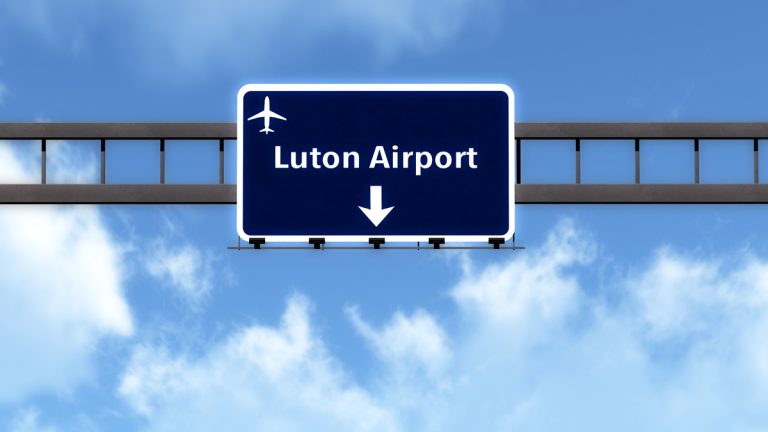
London Luton Airport: The One-Terminal Guide
September 1, 2026
Which London airport is closest to the city centre?
September 1, 2026
Trooping the Colour 2026: how to reach London without getting stuck
June 17, 2026
Getting to Wimbledon 2026 – transport and travel guide
May 20, 2026
Hidden spots in London most tourists miss
March 31, 2026
Cultural events in London: a travel and planning guide
March 25, 2026